

Of the Non-Spoilers
Of the Goings on
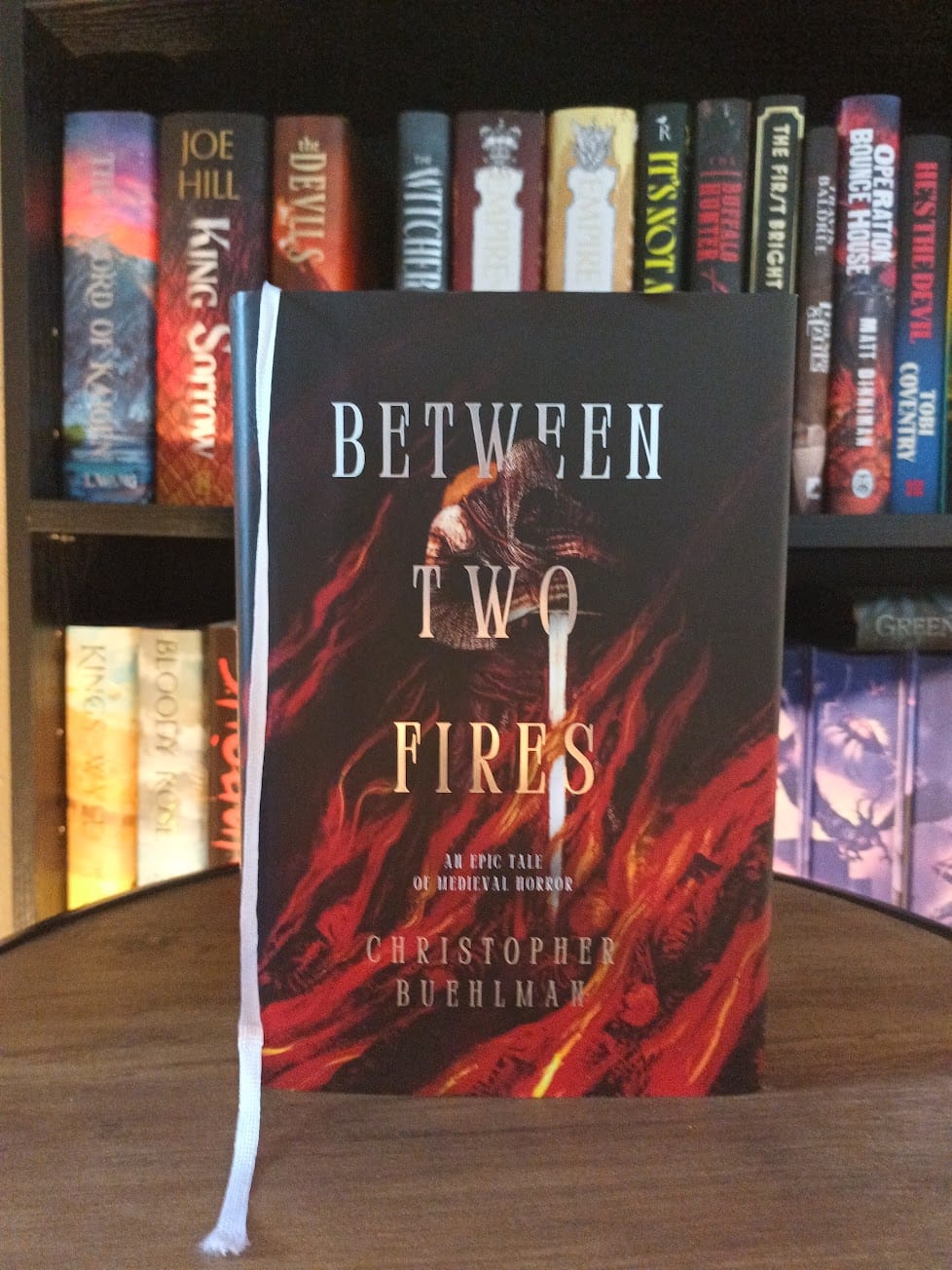
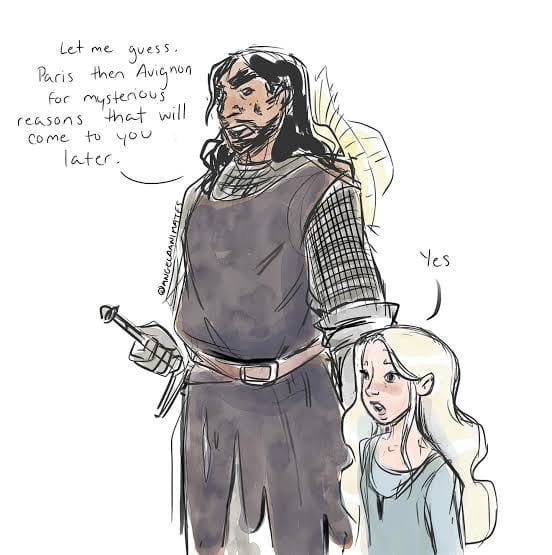
An acid tinged historical horror set in 14th Century France during the black death. Thomas - A former knight-turned-brigand seeking repemption - and Delphine - a mysterious young girl seeing visions of angels and devils - traverse the plague ridden lands towards Avignon, where it appears this fight is bigger than man.
Of the Thoughts of the Last Book Blogger
The premise of Between Two Fires hits the nail on the head for me. Medieval horror in general has always been a soft spot for me and to chuck in The Black Death too? I just knew I was in for a good time. This was everything that I wanted The Starving Saints to be and more. Very happy to have that itch thoroughly scratched now.
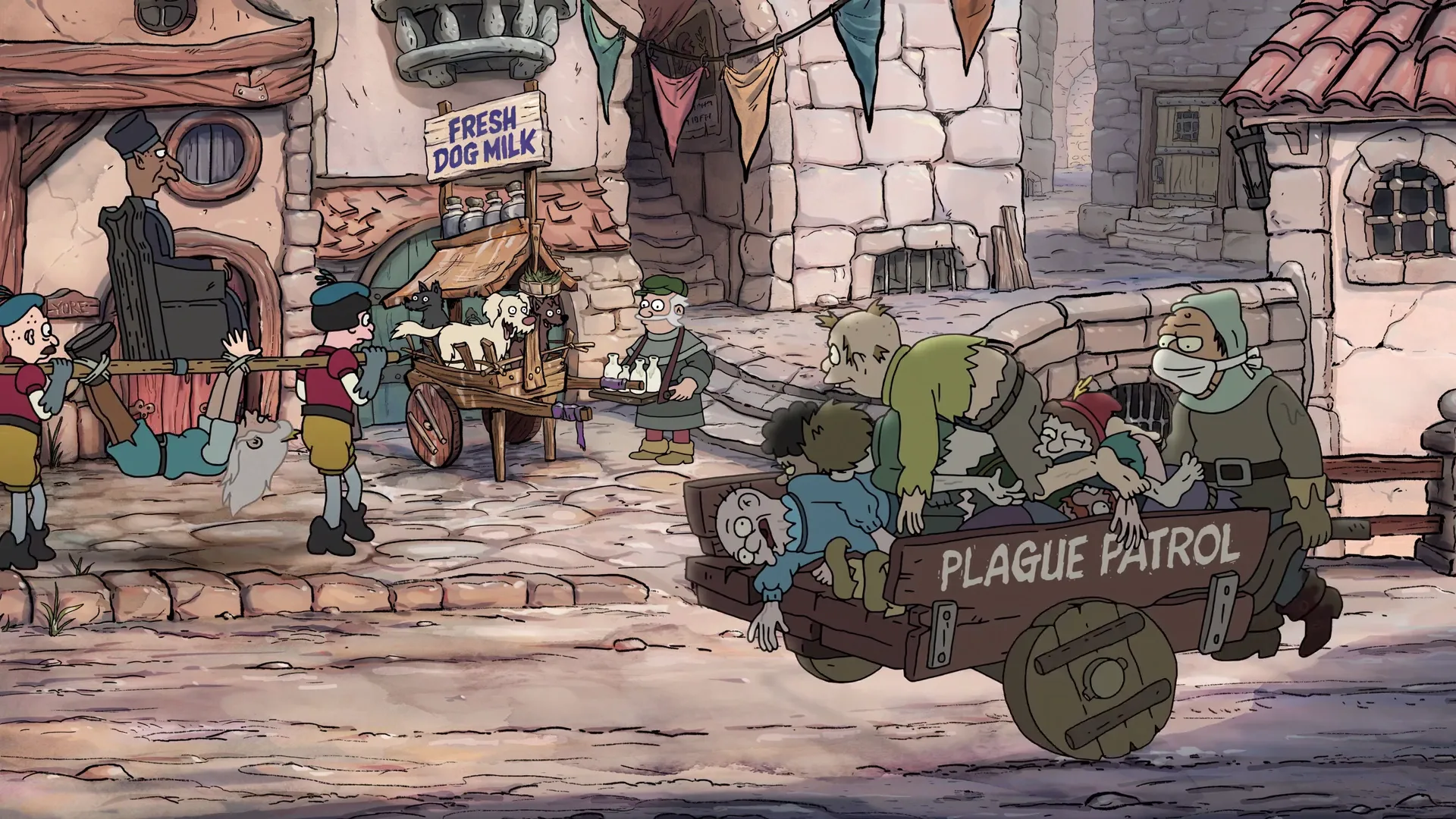
Unsurprisingly, the atmosphere remains bleak and moody throughout. The Black Death is at it's peak, leaving whole villages for dead. That is how our disgraced knight, Thomas, comes to meet the orphan girl, Delphine, in a village of dead. It's quickly sussed out there is something out of the ordinary with Delphine, yet with sickness rampant, the lines of one's own faith and delirium become entwined. Delphine speaks of a war between Angels and Demons, between Heaven and Hell, and how they must set out on a holy quest for divine justice.
Despite this doomy atmosphere there's sprinkles of humour throughout. In fact, the vibes of this book felt similar to a Jay Kristoff book, particularly The Empire of The Vampire trilogy. This also features a similar father-daughter type relationship between a disgraced man and mysterious young girl, set in a dying dark world.
If that doesn't do it for you then just know that this book was directed by Robert Eggers in my mind. Imagine the gloomy occult vibes of The VVItch meeting the acid tinged blood soaked violence of The Northman. That is Between Two Fires.
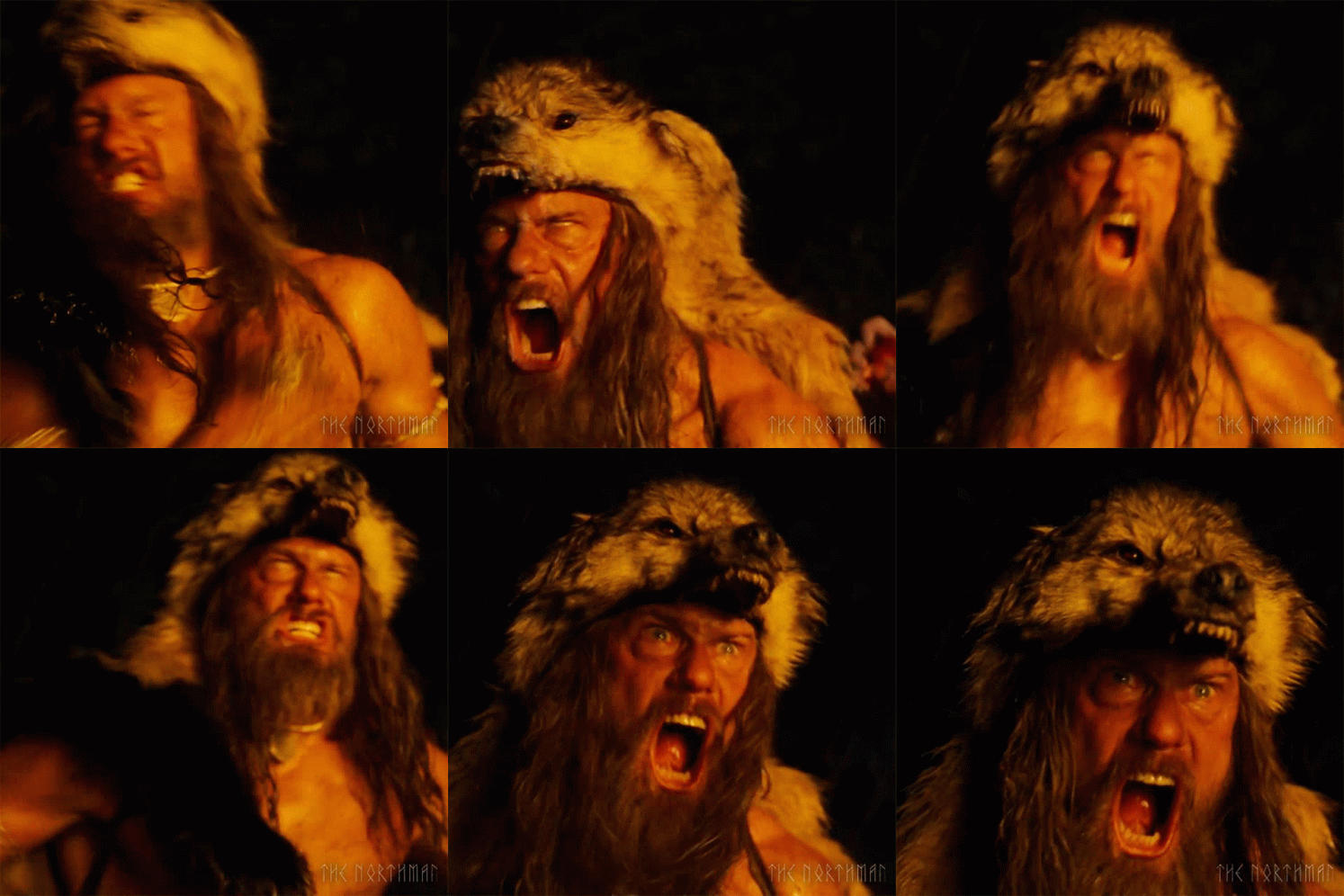
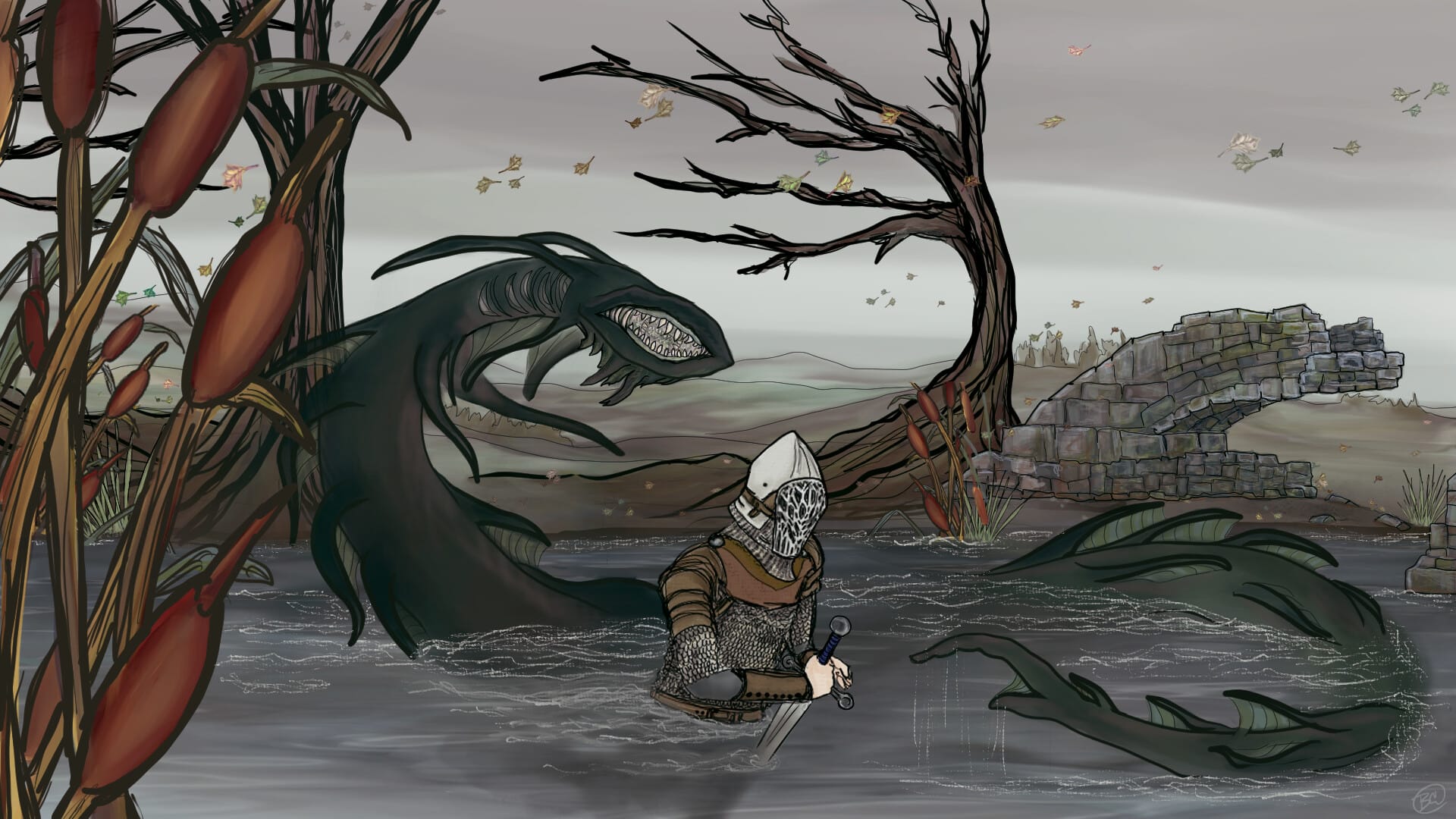
This book struck the perfect balance of serious, spooky and silly. Naturally, times are hard and the state of France is grave (pardon the pun), which offers the perfect playground for spooky silly fun. Don't get me wrong, this story is graphic and grotesque and I'm sure there are people who will disagree with my interpretation, but I found some sections to verge on goofy in a GOOD way. Fairly early on in the novel, there is a scene featuring some Lovecraftian fishy frog-type B-movie monster and I just found it camp as tits!
He turned to see the thing slithering toward him just under the water, its flat, froggy head as big as two tournament shields, its obscene whiskers trailing behind it, the spear making an S pattern in the water where it was still stuck in the thick of it. It was easily twenty paces long, the water rolling over it hypnotic, almost beautiful.
Given the setting of 1348 France, you can imagine how much of an impact religion has on the dwindling population. In a seemingly godless world Catholicism is tested to its limits as why would God allow such a momentous disaster as The Black Death to occur? Just like its characters the reader is also forced to question what is real and what is fake.
"Blasphemy is serious."
"This from the man who took communion from a monkey's head."
"That really happened?"
"If we both remember it, I'd say yes."
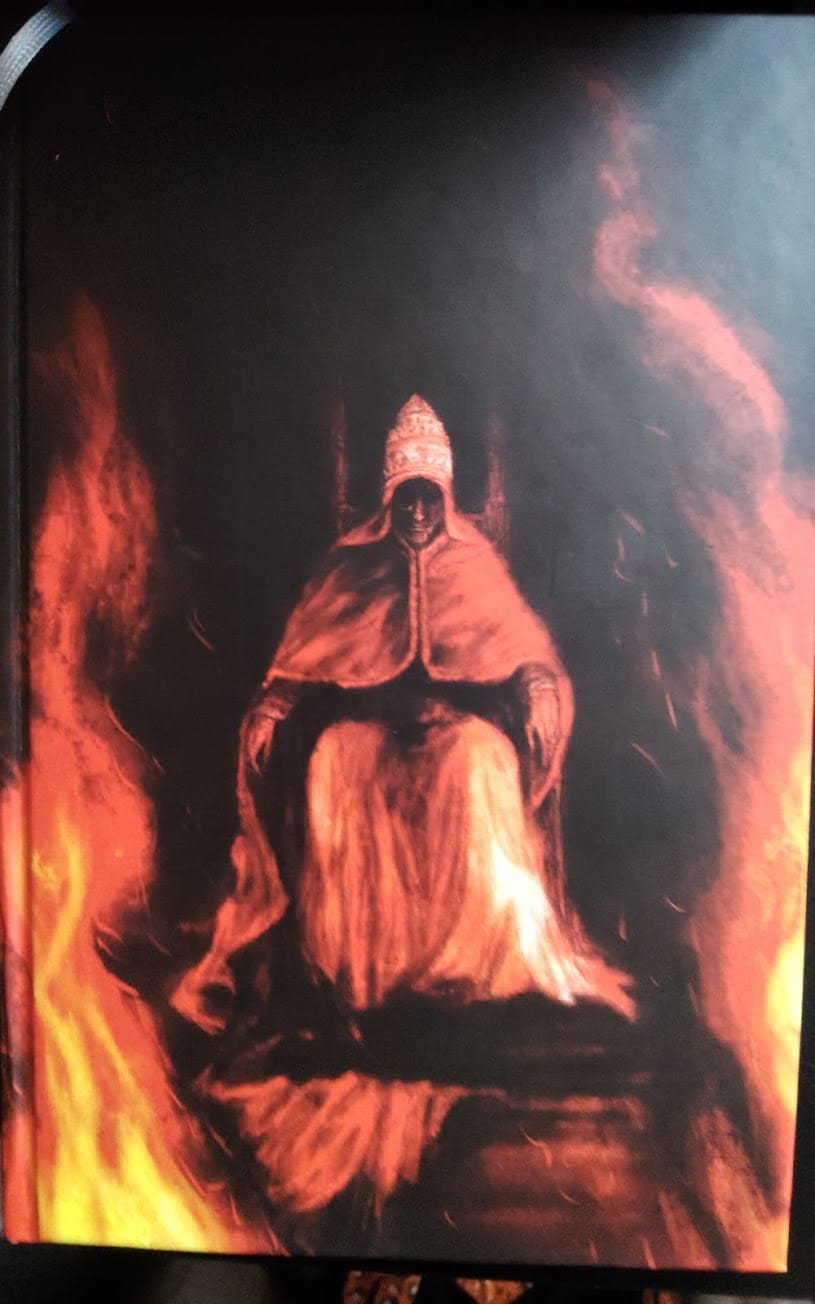
Say what you want about Catholicism, but the mythos surrounding it is very interesting to me. Christopher Buehlman invites us to see Catholicism through a horror tinted lens. The gothic cathedrals, the pompous pope robes and the frightening imagery of fallen angels cursed in Hell.
These angels are depicted as being biblically accurate genderless celestial beings. It's amusing to me how Catholics can depict these genderless beings in a divine light, yet someone in our society who is gender non-conforming must be mentally ill... There's no other explanation.
It's this Catholic mysticism combined with the gloomy medieval atmosphere and goofy practical effect B-movie aesthetic that makes this book so engaging. It's hard to figure out where this book is heading but rest assured it leads to gothic macabre absurdity. My advice - Allow yourself to be taken along for the ride, allow yourself to question what's real or fake, allow yourself to be fully immersed in this acid trip of medieval horror.
🌕🌕🌕🌕🌖 - 4.75 Stars
Of the Spoiler Inclined
Okay, so I spent the majority of the book questioning whether Delphine was an Angel or a Demon. It is heavily hinted that she is some sort of angelic being, yet her motives and intentions remain shrouded in a dark mist. She purposefully withholds information from Thomas, which is typical behaviour of the malignant. It was only when, I discovered that her blood is lethal to the demonic entities that it confirmed to me that she was of the benevolent kind.
Thomas goes on a real journey here in many different bodies. It's my understanding that Delphine was able to transfer the soul of Thomas from one body to the next however, these scenes were as a fever dream, where he would even be kissing himself to transfer his own breath. It's scenes like this that will make more sense on a reread for me now that I know more context.
Speaking of fever dream what an ENDING! I was not expecting this book to literally go to hell. When Thomas dies, he is punished in hell for an eternity (although it felt more like 10 minutes given the short page time).
"No! No!"
It ate him.
It hurt.
This scene played out innumerable times, with every sort of variation, but always ending the same way. Each time, he tried to reason with it, or to fight it, or to otherwise avoid the excruciating finale. He told himself not to try that the end was inevitable, but even after he resolved to give up, still he ran away from it, or tried to use the table to block it, or any other ploy he could devise, because it hurt just that much. At length, when he gave up trying and even speaking, the interaction shortened to nothing more than its reading off his name and sentence
Thomas de Givras, I damn thee
and then chewing him down alive.
He shivered and let it.
I damn thee
He cried and let it.
I damn thee
And then he just let it.
Eventually he even stopped yelling, and that was when they decided he was ready for something worse.
This scene emphasises the absence of hope in hell. It's interesting for me to see Hell being so opaquely described, as it is oftentimes simply referred to and not a literal place. Yet Thomas was for sure in hell. This sort of torture reminded me of a Japanese music video, which also repeats the same death over and over.
This is all after a battle between Angels and Demons. I wasn't expecting such a grand epic action scene to be the climax of this book but I was pleasantly surprised. I appreciate how Christopher Buehlman was unafraid to take this story to the extremes of hell and what's more epic than humungous divine winged-beings battling it out
It is also revealed that Pope Clement isn't the real Pope, but has been replaced by a demon. Delphine then resurrects the true pope and the face off begins.
Luckily there isn't too much to figure out as the fake Pope Clement turns into some fly headed winged lion beast that initially kills both Thomas and Robert. I mean... WTF! There's something truly epic about a pope vs pope fight and I was gripped. This book ended up diving so deep into angelic divinity that I felt as if I was reading a Laini Taylor book.
Now, the ending is convoluted. Heck, even this spoiler chat is all out of order. But that is far from a bad thing! It's complicated how it all plans out but what is simple about Heaven and Hell? I am already looking forward to reread this one as I am sure I will pick up on much more of the theming and questions asked to the reader. For this round though, I picked up on more than enough to consider me impressed!
Some of the theming is more obvious for the first time through, as shown in this quote:
"Two angels and a devil had tumbled into the water.
Three angels came up.
Forgiveness, then, was possible even for the worst.”
This represents the idea that any soul can be saved, not matter how depraved and corrupt. A baptism of good will can absolve oneself. This is a surprisingly hopeful tonal shift and offers the reader hope that all is never lost. This is a beautiful quote that truly captures the celestial vibes. Do I agree? I don't know. I believe it is always possible for evil to turn good, but knowledge of the fact doesn't make the occurrence any more frequent. It would seem that Christopher Buehlman is somewhat more hopeful for the future than I am!
Furthering on the idea of Hope, I was also not expecting this to have such a hopeful, happy ending? Thomas is resurrected and opts to remember all that happens. He is even reunited with his wife, (the logistics of which I am still unsure on) but decides to leave to be with Delphine, who contrastingly no longer has the knowledge of the divine events. The war between Angels and Demons has been simply brushed over as an earthquake adding to the already apocalyptic times.
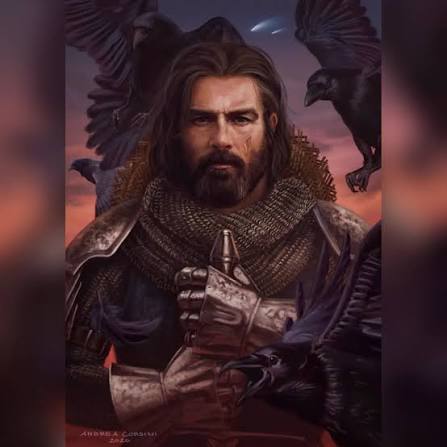
Thomas goes on a heroic journey of redemption. He was never depicted as being evil. In the very first chapter he is shown to save Delphine from that very evil. Yet, he does state that he has been that monster he know hates. This isn't surprising given the brutal nature of medieval France during the Black Death. Survival is the only thing on the mind. This links to questions of Faith as when one is experiencing such phycological torture, is it feasible to resist all temptation? By the end of the book, I truly believe that Thomas has forgiven himself, and absolved himself of any sin. Just like the devil tumbling into the water and emerging as an Angel.
Matthieu is a gay alcoholic priest who joins their journey. Given his sexuality of course there is ambiguity of faith. His attraction to men forced him to lose the trust of his congregation making him also go on a journey of redemption. Unlike Thomas, I fear that Matthieu didn't fulfil his own redemption as he is sadly killed by some Ditto-severed head-blobby-tentacle-stingy thing in the River Rhône. This is where his brother Robert comes into play. It's a shame that we don't see Matthieu and Robert interact because it would have been a nice reunion and perhaps that meeting could have been what fulfilled Matthieu's redemption arc.
There's much more to unpack here and I am certain there are many details that have gone over my head on this first read through, but that's honestly what makes this books so great! Buehlman is able to say so much in a single line, as he has already meticulously laid out the thematical groundwork. An example of this can be seen in this quote:
He was nearly out the door when she tapped her ring three times on the bench. Bull. Fox. Lamb.
Not only does this quote reveal the woman to be his wife, given that this is a reference to their wedding night where they had sex three times once like a bull, once like a fox and once like a Lamb. This could also be interpreted as Thomas' own journey. Bull - Knight. Fox - Brigand. Lamb - Monk. I believe that these three animals could represent the three sides to Thomas, not only in the bedroom but across his entire life. As a Bull, Thomas fought ferociously as a knight. As a Fox, he scavenged and roamed as a Brigand. And as a Lamb, he found peace and innocence in his life as an old friar/Monk.
Upon finishing Between Two Fires, my mind was racing with questions and answers, all surrounding the last 30 pages. Everything came together in such a grand fashion, it's hard to take it all in. I also appreciate how not everything was answered and so much is left to the reader's own interpretation, whilst still having everything tied in a neat knot.
There's no doubt that this is a feat of great literature that is seemingly tailored specifically to my taste! I can not wait to dive deeper into some of Christopher Buehlman's other works!

Comments